Showing posts with label food. Show all posts

Wednesday, February 17, 2016

A New Start!


Post-defence celebrations!


Many important things have happened since the last time I wrote here, the most important of which is: I successfully defended my thesis!  The defence itself went well, as did turning in the thesis, but the week prior to each was rather stressful, trying to get everything done. Not only that, the week prior to my defence I was feeling rather under the weather, and to top it off, on Wednesday night my computer DIED. And I hadn't backed up my slides and notes sufficiently. So I basically had to redo the majority of the slides for my defence which was NOT NOT NOT fun at all. As you can imagine, I was in a bit of a state. But as I said, the defence itself went well. The morning of, I actually found that a friend of mine had left "before" and "after" gifts for me on my desk -- the before was a stuffed snake toy (in reference to this amazing essay), and the after was a flask of whiskey. Both were very much appreciated and helped calm my nerves.


Not only did I defend, but I have also been hired as a post-doc at NRAO's Green Bank Telescope, in West Virginia, where I will be starting in late March! I'm really looking forwards to the new position, and I expect to learn a lot.  I've been joking that this will make me a "real astronomer" since I'll actually be working at a telescope and taking actual observations.  While I am an observationalist (as opposed to a theorist), all my data for my thesis has been from radio observations. So, while I wrote numerous proposals, got approved for telescope time, and had to figure out the details of the runs, I didn't actually do the observations myself --- I sent off  the relevant info to the VLA, and they scheduled the observations and sent me the data back. Even though I've been out to various telescopes, the only time I actually controlled a 'scope and took my own data on was on a class trip to MDM observatory in Arizona, and was for a class project, not my research (though it was a great experience). I am also not counting the observations I've done teaching labs or doing outreach, since those experiences aren't taking data for research so much as showing people the stars and explaining the awesome stuff that exists in the sky.

Anyway, I turned in my thesis on January 15th, and defended on January 29th. Since then, I've moved out of my apartment in NYC and shipped a bunch of stuff down to WV, where it is in storage. I stayed with my parents in Baltimore for a week, and now am in Cambridge in the UK visiting Benson. I'll be here for about a month, then going back to Baltimore until I move to Green Bank. I haven't bought a new computer yet -- I kind of want to wait until I've gotten to my new job, to see what kind of set up I will have there and what kind of computational needs I'll have. For now, Benson has kindly given me his old computer (very similar to the one I had that died) that he is no longer using, having upgraded about a year or so ago. So I can just use this one until I've decided exactly what I want/need to replace my old one. Happily, I did back up *that* computer regularly, even if I hadn't backed it up sufficiently close to the crash to save my slides, so I have all my work. The only thing I lost was the slides and notes. Which, well, was enough.

I've been having a lovely time in the UK. It is always good to see Benson and spend time with him, and it's been lovely to just relax and not worry about work, to take a real vacation. This past weekend, some good friends of ours -- Dahlia and Paul -- were in London for *their* vacation, so we met up with them twice! They came into Cambridge one day, and we went into London another. When in London, we went to a great restaurant -- Dinner by Heston Blumenthal -- which we all REALLY enjoyed a LOT. They take historical British recipes and modernize them somewhat to make an absolutely fantastic menu. We all got different things so we could try as much as possible, and split several of the appetizers and desserts. It's hard to chose favorites, since everything we got was fantastic, but I'd particularly recommend the roast marrowbone and meat fruit appetizers and the tipsy cake for dessert. The mains it's harder to chose one thing -- the duck breast was amazing, the ribeye was an extremely flavorful steak, and the halibut was a really well made dish.

Anyway, again, I've been having a great vacation. And I am both really happy and kind of sad about finishing my thesis -- it was so much work, it's very strange to be done with it. Even if research goes on and ever on, and I will be continuing my work on parts of it, having one big written work describing everything I have worked on is an odd experience. Here is 6 years of my life in 231 pages, right?? But for now, I'll relax a bit longer and then start on my next big experience!


Thursday, November 12, 2015

Life update (and Soylent review)

Hi all!

It's been ages and ages, I realize, but I never intended to let this blog die. I've just been in the midst of writing up my dissertation and job hunting. I'm going to be defending my thesis in a couple of months, likely in late January/early February, so that's been my main focus for a while now. I haven't gone on any really interesting trips since the last time I posted, and while I have been cooking some and have been to some awesome restaurants (most notably Eleven Madison Park last May!), I haven't been doing nearly as much foodie stuff lately. The most interesting thing I've done food-wise lately was cook borscht (which turned out really well, admittedly) and to try out Soylent. If you aren't familiar with the product, it's basically a drink designed to replace food -- it's balanced so that if you consume nothing but, you still fulfill all your nutritional and caloric needs without needing to cook or prep anything.

But Jennifer, you say -- you LOVE cooking! AND eating delicious new things! Why on earth would you replace food with something like that? Well, for one, I love to try new things. And I really like the *idea* behind it -- making it easy to get all your nutrition from one source in a relatively inexpensive manner (~$2.30 per bottle right now, cheaper in powder form) seems like a good idea to me. And if I'm ever going to replace food with something else, now is the time -- like I said, I'm in the middle of writing up my thesis. I'm *busy* and when I'm not busy I'm frequently *tired* and don't feel like cooking up something complicated. If you compare the frequency at which I've been cooking for the past six months ago to any other six month period of my life since moving into my own place (albeit with roommates, but also with a KITCHEN) during my junior year of undergrad, you'll notice a SHARP drop in how often I've been doing so and a SHARP rise in take-out and super-simple instant type dinners which require minimal effort. Also, it's named after a famously cannibalistic product which I find, frankly, hilarious. Know thy audience, I guess.

Anyway, they recently updated the product so that it's no longer just in powder form -- originally you had to mix it up yourself whenever you wanted it, but now it comes in conveniently pre-made bottles which I can grab on my way out the door if I'm in a hurry. They're 400 calories a pop, so in theory you can drink 5 bottles a day to get your full 2000 calories, but I maybe have one or two a week at most, when I'm tired and hungry or in a hurry to get somewhere and need food fast. Good for a quick breakfast or snack. I bought a 12 pack a little over a month ago and recently received my second one last weekend.

Taste-wise, it's kind of like a cross between unsweetened soy milk and those last liquidy dregs of oatmeal that collect at the bottom of your bowl, in that it's got a bit of thickness and texture. It tastes fine. A bit bland, but really, I like soy milk, and that's the closest thing to it, I think. Thick soy milk with a hint of oatmeal. Fine for a bit, for a meal here and there, but if I lived off the stuff I would get cravings for actual flavor pretty fast. 

Anyway, that's all for now, this was meant to be a quick life update mainly. No promises for future update schedules because right now my dissertation writing is the most important thing.


Friday, August 1, 2014

Travelogue: Scotland


Eilean Donan Castle
Having never been to the UK before, I really wanted to see some parts of it that were a bit further afield. So it is important to grab opportunities to travel when they come. Last week, there was a mini nova conference near Manchester, just the local astronomers around the UK which they hold every 6 months or so, kind of informal but a good opportunity to see other astronomers who focus on novae and even some of my collaborators that I rarely see face to face. This was actually held on my birthday -- I made some comments to Benson about this, saying that the ONE DAY I knew I had to work ALL SUMMER without taking off was, of course, the day I'd most want to NOT work and take off and celebrate. So, anyway, the day prior, I rented a car, then woke up at 6:15am on my birthday to drive 3 hours to the conference (with Benson navigating/snoozing in the passenger seat -- he just worked in a nearby library the whole day while I was chatting with folk).


Benson and I at Jodrell Bank
All in all, it was a decent birthday (terrible traffic aside) - I had a lot of good conversations with people, talked about science, got some feedback on my research, and so on. But because we were already going up towards Manchester, Benson and I reasoned it was a good time to just keep going north. Which is why we rented the car for a full week and spent a long weekend in Scotland! So, after spending a chunk of Friday afternoon visiting a collaborator at the Jodrell Bank Observatory (the central hub for the radio telescope array eMERLIN, which is spread over the UK -- we got quite a nice tour of the facility, in fact) we drove up to Edinburgh. Our first night was a simple one -- we just checked into our hostel (which was made entirely of shipping containers and absurdly inexpensive), went into town and walked around old town. There, I lusted over the multitude of plaid clothing that was *everywhere* (if you ever look through my wardrobe, you may notice that I have a fondness for it), and, more importantly, went for dinner and drinks. Naturally, I had to have haggis for my first ever trip to Scotland... followed by four shots of whisky (divided by two, though, since Benson and I split them). You see, we deliberately went to a place called Whiski, which I would highly recommend, which has 300 different whiskies available for tasting. Which is a good selection, I think. We actually went back again on Monday night to get 3 more shots. Benson is a BIG whisky connoisseur, so I pretty much let him chose what we got. Between the 2 tastings, we got one whiskey from each of the regions -- Highlands, Lowlands, Islays, Speyside, Campbeltown, and the Islands, plus an extra Lowlands -- I don't quite recall what we got, honestly, you'd have to ask Benson -- but they were all very good. I tend to prefer whiskies that don't have an overly strong peat taste and that are smoother, but I'm also not that fussy or knowledgable about the whole thing. I know more now than I did at the beginning of the weekend though.


The next morning, we arose from our shipping containers,  bright and shiny early, and drove to the Isle of Skye. Which was a lovely drive across the lowlands and highlands, going through a national park at one point. Now, you'll note that I was driving. Benson hasn't really driven since he got his license 10 years ago, and doesn't really trust himself behind the wheel. Whereas, I actively enjoy driving (assuming no traffic). This was my first experience driving in Britain, however, and it took some getting used to not only DRIVING on the wrong side of the road (and through endless roundabouts), but also shifting gears with my left hand. Manual cars are the norm in the UK, and much cheaper to rent, you see. My dad taught me how to drive stick shift when I was in college -- he kept a manual car around in part for this purpose, and had me drive said car to my camp job over the summer every day, so I'd get used to it. So it's a useful skill! I never finished writing up my last summer's activities (whoops) but this came in handy last year when we were in Italy, as well -- we stayed at a friend of Benson's house, and borrowed his grandfathers car. Which was stick. And I was the only one of the four of us that could drive -- which made me the designated driver throughout the Italian countryside, and enabled us to see much more of it than we would have been able to otherwise. So worth holding back a bit more on those italian wines....

Anyway, the Isle of Skye was GORGEOUS. We did a lot of hiking over the weekend, drove all around the island, had lots of delicious fresh seafood (and were even taught how to shuck oysters by the proprietor of the wonderful Oyster Shed), saw a TON of sheep (sheep EVERYWHERE), visited the Portree harbor, and, naturally, toured the Talisker Whisky Distillery. Talisker is one of Benson's favorite whiskies, so we got to sample a few very nice ones, too. We stayed at a lovely little B&B which overlooked the Eilean Donan Castle in the town of Dornie (not on the Isle of Skye itself, but within driving distance). After we spent a very nice 2 days in Skye, we headed back to Edinburgh, to explore the town a bit more in depth. We still mainly wandered -- I bought myself some plaid items as souvenirs, we had more delicious food, more whisky at Whiski, visited the main castle there, and climbed up Arthur's seat for a gorgeous view of the city. All in all, a good trip! Now, we're back in Cambridge again, which means... we should probably start thinking about buying tickets and planning our trip to Greece for the last week of August. Yeah... things to get on soon...


The view from Arthur's Seat


Sunday, March 30, 2014

Homestyle Cooking: Meatloaf!

Everybody has their own recipe for meatloaf, and each one is just the way you had it growing up, and no other recipe for meatloaf can compare. What good is meatloaf if it's not just the way that mom/dad/grandma used to make?  In college, my biggest almost-fights - recurrent arguments? Joking arguments that almost weren't jokes? - with my friend Abe were over our respective meatloaf recipes. His recipe involves lots of ketchup, with more ketchup served on top - meatloaf, to his family, is a mechanism for getting rid of ketchup in a tasty fashion. Whereas I would never let ketchup within a MILE of my meatloaf - who eats meatloaf with ketchup??? Meatloaf is nostalgia, personified (food-onified?). As such, visiting my folks last week over Spring break, and having my grandfather over, I happily use my mothers - or rather, her Aunt Grace's - meatloaf recipe for some good home cooking. I don't tend to make it for myself very often, as it's rather a lot of food for one person. On the other hand, it does freeze well. But when I make it for family, well, there is never enough left to freeze!

Meatloaf
1.5 lbs ground beef
1 c. seasoned bread crumbs
1 c. tomato sauce
2 eggs
1 medium onion, chopped (optional)
1/2 tsp salt
dash of pepper

Preheat oven 400F. Mix all ingredients thoroughly - I usually just do this by hand, as I find that gets the whole mixture a bit more homogenous. Now, this recipe is a bit flexible, and usually when I make it it's with a little more (or less) meat. As such, I usually give it a good mix, then add more tomato sauce or breadcrumbs as necessary. You want the meat to be firm and moist - holding it's shape well - you don't want it to be overly crumbly from too many breadcrumbs or overly moist or slimy from too much tomato sauce or too many eggs. When cooking in Baltimore, I actually usually make a 2+ lb batch, which I split into two smaller loafs, saving one for a second meal with my folks.

Now, once everything is nicely mixed, and (for larger batches) split into equal loaf sized parts, you shape your meatloaf. This is the ... trademark? ... of my meatloafs. Ever since I was very small and helping my parents make meatloaf, I've always always always made my meatloaf into shapes. A cat, a Christmas tree or snowman, something seasonal. I've found that rabbits are particularly nice. Bake for 1.5 hours (more or less - obviously for more meat, cook longer, for less, cook shorter). Serve without ketchup.


Monday, May 20, 2013

Summer Plans Confirmed!

So this is just a quick blog post in which I'm REALLY excited for my summer plans, which just came together over the weekend, in chronologically reversed order. So I wanted to gush about that for a little bit!

Benson is going to two conferences this summer, in July: one in Warsaw, Poland, and the other near Barcelona, Spain. I had originally been planning on flying out to California for his graduation in mid-June, but when he invited me to go around Europe with him for a couple weeks, I decided that Europa took priority over Cali. This weekend, we spent a large chunk of Saturday discussing our plans and booking flights. Since travel within Europe itself is relatively inexpensive, and we knew we wanted to take 2 weeks to travel, the whole continent was pretty much our oyster. Which turned out to be a little problematic, since we both love to travel and want to go EVERYWHERE, eventually.

Our planning went in reverse: We knew we wanted to end in Warsaw, of course, since that is where the first conference is and therefore where I must end my trip. I'm going to actually be there for the first few days of the conference, probably looking around Warsaw on my own while Benson does conference-y things. I've never been to Poland before, and Warsaw should be really interesting. Just prior to the conference, we'll be in Italy: a friend of Benson has family near Rome, and invited us to stay for the week before the conference. I've been to Rome before - when I was in undergrad, my family took a summer and spent 5 weeks in Europe, two of which were traveling around Italy and the other three in France. Rome was one of the stops we went to, so I don't feel the need to do ALL THE THINGS in Rome or nearby... it will be nice to explore smaller towns and take a more relaxed trip, and with people who know the area - not to mentioned home cooked Italian meals!

Prague was the last place we settled on - as I said, since travel is cheap within Europa, we could have gone pretty much anywhere before heading to Italy and then Poland. [An amusing side note: when Benson was describing this trip to his parents, they were apparently under the misapprehension that the conference was in PORTLAND instead of POLAND. A slight difference there...] Anyway, Prague was actually one of the places we had been thinking about before we got the Italy invitation, since it was within reasonable distance to Warsaw by train. So after about an hour discussion of all the awesome places to go in Europe, we kind of defaulted back to Prague on the basis that while there were many we want to go, most of them we'd want to spend more time than available (Istanbul, Greece, and Norway were dismissed for these reasons, for example, since although those are all trips we've been wanting to do for a while, none of them could be done justice in only 5-6 days). My parents have been to Prague, and they highly recommended it: they thought it was fantastic, like a fairy tale city with great music and culture.

So once Europe was worked out, we just had to figure out if we were doing anything prior. In order to see friends, not to mention so that we can take the same trans-continental flight, Benson is going to be in NYC for a few days prior to this vacation. Now, Benson very recently defended his dissertation and received his PhD in Physics at UC Santa Barbara. He'll be going to Cambridge, England, for a three year post doc starting next October. This, of course, is cause for great celebration.

Now, I did get Benson a present for graduating when I was out there over spring break: whiskey! Benson is a big fan of whiskey in general - he has been since undergrad. In fact, he was given a list of quality scotches by one of the professors at Brandeis, which he's been studiously(?) working through, trying all varieties. This is known as "Craig's List", after said professor. Education is a wonderful thing. [Indeed, once during a lab class with said professor, Benson was talking to him about scotch, and I had to interrupt, said I, "with a non-whiskey related question."   "You have to get your priorities straight" responded my professor.] We both like whiskey a lot, is the point, though Benson is more into it than I am - I appreciate it, but don't think I'm a connoisseur or anything. Before my 25th birthday we made a point to go out and drink scotch older than we were (25 year old Bowmore) at Angel's Share in NYC (a most excellent speak-easy, with great cocktails and liquor selection). Since then, we've actually managed to replicate this feat with two additional whiskeys, despite our own aging: my dad has a friend who collects whiskeys, and I've received a couple of very small (as in several ounces) bottles of whiskey since, as presents; so we've also tried 27 year old and 29 year old scotches as well, now. Since I wanted a nice, interesting gift for Benson's PhD, something he'd not gotten before, my dad's friend recommended several bottles of scotch that he thought would be good for such an occasion, from which I chose Aberlour A'Bunadh. Which is very nice indeed.

Now, after that somehow lengthy aside on whiskey (not a waste): Although I gave Benson a present for receiving the PhD, we wanted to go to a nice restaurant to celebrate his graduation, as well. I've mentioned before that we're both foodies to a certain extent, and I'm living in New York City. This means we have access to some of the finest restaurants world wide. This is not an exaggeration. Therefore this morning, exactly one month to the day prior to when we wanted our meal (and the first day possible for booking), at 10am sharp (when the booking line opens) I called Per Se. Per Se is a three-Michelin star restaurant. Last year it was number 6 on the worlds Best 100 Restaurants (which was top spot in the USA). You may recall that in February I was able go go to the restaurant on the number 61 spot, in Cape Town. This year Per Se was number 11 (second best in USA, the top being Eleven Madison Park, also in New York, which is the place I plan on going for MY graduation!). It is run by Thomas Keller, who happens to own TWO three-Michelin star restaurants, the other one being The French Laundry, in California. And as regular readers may recall, my most prized cookbooks is The French Laundry, which I have several different recipes chronologued in this blog. Yes, this is Thomas Keller's OTHER three-Michelin star restaurant. Repeat: I called right when the line opened, at 10am sharp, the earliest possible time. I then proceeded to wait on hold for 25 minutes, and, when I got through, there were only three time slots left. So Benson and I are now proudly possess a reservation at what will be the most expensive, exclusive, and hopefully amazing restaurant that we have ever eaten at to date. Benson is literally booking his flight around this restaurant reservation. To say this place is popular is an understatement. To say I'm excited is an understatement. And of course, finally, to say my summer is going to be awesome is hopefully also an understatement!

Friday, May 17, 2013

Watch City Steampunk Festival


Kaila and me in our Steampunk outfits
For undergrad, I attended Brandeis University in Waltham, Massachusetts, where I was a double major in Physics and Mathematics. As I've mentioned before, one of my roommates, Kaila, still lives in Waltham while she goes to graduate school in Boston. For the past few years, Waltham has hosted the International Watch City Steampunk Festival every spring, hosted by the Charles River Museum of Industry and Innovation. The main street of town is converted -  the park plays live music and sets up booths for individual venders, the shops and pubs and restaurants decorate and offer special deals for festival attendants, there is a live parade, and there are all sorts of panels and events all over town.

For those not familiar with steampunk, you can think of it as a particular brand of science fiction, based on 19th century/Victorian age technology: think Jules Verne, Orson Wells, where everything is steam powered and full of gears. An alternate vision of the future that people in the past might have conceived. It's a LOT of fun to dress up and be silly. Waltham used to be a center for industry and manufacturing during that time period, and is particularly known for its watch factory, which inspired the festival's name. So every year, I've enjoyed going back and visiting my old haunts from undergrad while dressed up to the nines. They always host it on Mothers day weekend (to my mom's dismay, but I've been in Baltimore a lot recently and so we celebrated early) so this past weekend I headed up for the festival.

And also, trebuchet demonstrations,
hurling ice into the river!
This festival had a myriad of activities. Panels (like Victorian Technology and the Steampunk Vision, and Waltham and the American Industrial Age), workshops (like Electronics for Minions, and Thrifty Steampunk), lots of ongoing music and shows (like the Dark Follies Circus, a pirate show, belly dancers, a fiddle circle, a one-man band who makes his own very odd musical instruments, and the improv show "To Whom Does That Line Pertain To, Perchance?"), the yearly pub-crawl (woo!), a steampunk themed LARP (live action role playing - lots of running after people with nerf guns and foam swords!), lots of venders (selling corsets and spices and games and trinkets and much more),  and just in general lots of wandering around having fun and looking at other people's costumes. And naturally, for a steampunk festival, I have to have an awesome costume of my own!  A few detail pictures:

Homemade cincher


My cincher also works as a holster


Key necklace
Pocket watch, or rather,
pocket sundial/compass
What I generally wear has developed over the past couple years, adding various elements as I find them - for example, my first year, I wore a skirt I got from my mom, and a different shirt, and I've added a number of accessories. The major pieces of my current outfit have come from various thrift stores - boots, skirt, and shirt. I bought the hat and the necklace at the first festival that I attended a couple years back. My gun (a painted water pistol) is also from my first festival -- I got it for participating in the pub crawl that year (We had to go from bar to bar, fulfilling quests and performing tasks for various characters in order to recover the secret plans. And drinking.) The bag I carry around all day is actually what I usually use as my computer case, which I got as a graduation present for high school and have been using for years, and is a great leather bag with brass fasteners and hooks. And the cincher I made myself, in preparation for the first first festival I attended: I found a pattern online, used buttons from my mother's button jar, and got the fabric from some old curtains I found at a thrift store -- a regular Scarlett O'Hara move, that! Anyway, it all comes together very nicely, I think, and was done relatively inexpensively. Honestly, making up your own outfit is a lot of fun, I highly recommend it if you want to attend this kind of festival, and there is a lot of room for interpretation and personal creativity within the genre. Examples:

A local group set up a working blacksmithery
Behold the mechanical arm!

All in all, it was a pretty awesome weekend, and a great excuse to go up and see Kaila and wander around Waltham again. It's always nice to visit my old favorite spots (like Lizzy's Ice Cream, or the More Than Words bookstore). I'll be going up to Waltham again in about a month, for my fifth(!) year reunion, but I won't get to wander around in a costume then, alas. But there is always next year for that - I'm thinking this summer I may try and mod my own nerf gun... we shall see!

Thursday, February 28, 2013

Caramelized Onion and Goat Cheese Quiche

I've been pretty busy catching up with work and such since I got back from South Africa, but everyone needs to eat, and if you are going to eat, you may as well eat well! This is a favorite dish of mine, which I only started making about 2 years ago - I wanted to make a quiche, but the only vegetable I had around the apartment were onions (I always have onions and garlic floating around - they are bare necessities in my kitchen), and I happened to have some goat cheese in the fridge. So, I looked up a recipe for onion/goat cheese quiches and found a LOT of them - so this is my blend of several recipes scattered across the internet.  As a bonus, this is a good vegetarian meal! 


Caramelized Onion and Goat Cheese Quiche
1 standard pie crust
2 red onions
1 tbs balsamic vinegar
4-8 oz goat cheese (depending how cheesy you want it, or how big the packet of goat cheese you bought happens to be... I'd tend towards more than less, but it's really up to you. I usually just put in the whole chunk of goat cheese I purchased.)
3 large eggs
1/2 cup milk
1/2 cup cream
nutmeg
salt and pepper
cayenne pepper (optional, to taste)


Onions: I put this step first because it takes the longest, but while the onions are cooking, you should deal with pre-baking your pie crust, as well. But to get a nice caramelization going on your onions, you need to cook them slowly, over the course of about an hour. First, french your onions. If you are not familiar with this term, that's OK, I wasn't either when I made this recipe for the first time. What you are going for is long, thin strands of onion. So, chop of the top and bottom of the onion, and peel it. Next, slice the onion in half, down the length of the it (from the top to the bottom), like an orange splits. Then, in the same direction, cut thin slices off of the onion, so you get nice long slices - see the picture to the left! Once your onions are all frenched up, put some olive oil in a pan on medium heat. Add the onions, sprinkle some salt over them, and cook for 10 minutes until they're starting to become soft and translucent. At this point, reduce the heat to LOW, and cook for about 30 minutes more (moving them around occasionally) until they're becoming brown and very soft. Add the balsamic vinegar and mix well, and cook 10 minutes more on low until they're caramelized and delicious! Then remove from heat and set aside.


Honestly, these onions are delicious by themselves, but take a while. So if you think you'll have use for them, you may as well cook some extras up while you are doing this. They're really good, sweet, even,  and consider that they're basically onions and vinegar. Mind, it IS balsamic vinegar, the most delicious vinegar ever! Silly though it may be, I still remember the first time I had it balsamic as a salad topping, at a German restaurant in DC - I was just amazed at how tasty the stuff was, and insisted my parents buy some right away for the next time we had salad at home. But then, I do tend to have a memory for food -  seriously, I can completely forget a face I've met only once, but take me to a restaurant I've been to once before, and I'll tell you exactly what I ate and how I liked it. Ah well.


Pie Crust: Preheat your oven to 400F. Make up your pie dough. Now here, I admit I cheat a bit. I don't actually make my own pie crust very often. I've made it via a mix, and I've made it when baking with friends who have their own recipes, but when I'm just cooking for myself, I generally cheat and buy frozen Pillsbury pie dough - it's pie dough, NOT pre-baked (as those tend to get dry), which you can cut up, or pre-bake yourself, or whatever you want to do with your pie crust. I pretty much always have a box in my freezer for spontaneous pie or quiche. Very useful! Anyways, once you have your pie crust dough, fit it into a standard pie pan. If you don't have a pie pan, I have, in the past, improvised and used a 8-inch circular cake pan, which will work just fine - however, I generally use my grandmothers pie pan, much easier to deal with. At this point, if you happen to have them, you can weight the crust down with pie weights. Alternatives include dried lentils, or beans, or whatever - the point is to prevent the bottom from puffing up and deforming while the crust bakes - I generally skip this step and it works out fine, but it certainly doesn't hurt to do. Pre-bake for 10-15 minutes (or whatever your pie recipe calls for) until its a nice, light brown. It will be going back in the oven later, with quiche in it, so don't over do it or the outer crust will get a little too toasty. (Mmm... toasty.). Let cool.

Onions and Goat cheese on the bottom
Filling and Baking: Preheat the oven to 325F. Blend milk, cream, egg, spices, and up to half the cheese until liquified and homogenous. Take your onions, and spread about half of them on the bottom of your pie crust, and crumble some more of the goat cheese on top of that. (In this particular pie, I was using 4 oz of goat cheese total - 2 oz in the blender, 1 oz on the bottom, and 1 oz sprinkled on top. I generally use a little more, but that's what I had around today.) Then pour your filling into the tart. Top with the rest of the onions and goat cheese (it will sink into the pie as you bake it, but you want it layered a bit). Bake for ~45 minutes until starts browning on the top - it's a good idea to check on it every so often, as you don't want it getting overdone, either.


Filled, not baked, and topped with
the remaining onions and goat cheese


This is friggen' delicious. My department has 'morning coffee' twice a week, with people rotating to bring in snacks to go with coffee, which I like to volunteer for every once in a while. Of the various things I bring in, this is definitely one of the most popular. I also like to bring in homemade bread with my bread machine, since usually one quiche by itself wouldn't be enough for everyone (and it tends to disappear FAST). On this occasion, however, I made it all for myself (and for my roommate, who made up a nice salad to go with it), for dinner and a nice lunch tomorrow.


Friday, February 22, 2013

Travelogue: Stellenbosch


This will be a short entry, covering just my last weekend in South Africa, for completeness. In other news, I've gone back and added a few pictures to the previous travelogues.


After my week and a half in Cape Town (and surrounding area), I decided to spend my last weekend elsewhere: WINE COUNTRY. Stellenbosch is a bit more than an hour outside from Cape Town, and is one of the larger towns in South Africa's wine country. I am, of course, a big fan of wine. So last Saturday, I took a tour run by my hostel, which drove me (and some others) to four separate wineries, each of which gave us tastes of 5 or 6 wines. This would be a grand total of 20, but since I was with a group, we also traded some sips with each other - plus, at one winery, I was being indecisive and the woman who gave out samples was kind enough to give me an extra two (small) tastes. At one location, we also had a cheese tasting (ALWAYS fun). So over the course of the day, I bought one very tasty red (Shiraz, from Fairview winery), one excellent sauvignon blanc (from Boschendal - yes, one of the wineries was in fact the location of the conference dinner, but since I really liked the sauvignon blanc we had that night I was happy I could go back and purchase it.) And of course, I'd previously bought a dessert wine at Delheim (which we stopped at during the after-conference tour). So I brought home a total of one red, one white, and one dessert wine, all three of which are delicious!

Regarding the rest of my time in Stellenbosch, I spent most of Friday just wandering around the town (in and out of shops, a local botanical garden, and finished with a delicious dinner from a culinary arts school's restaurant). On Sunday, I rented a bike and biked 10 km (each way) to Jonkershoek Nature Reserve, a nice little park where I found a picnic table and had a nice little spread (previously purchased for this very purpose). Just some cheese, crackers, figs, juice, and zebra pate. Yes, you read that right, ZEBRA PATE. I found this at an AWESOME little store in Stellenbosch (which allowed no pictures inside, alas) called Oom Samie Se Winkel (Uncle Samie's Store), which had the most amazing things. Like ostrich and peacock feathers, all sorts of spices, wine and odd spirits, random and obscure food items (like zebra pate), old books, and a full miscellany of old fashioned trinkets and oddities. If you ever go to Stellenbosch, go to this shop, seriously. Anyways, the zebra pate was interesting, but didn't have a strong taste (I could kind of imagine it was a little horse-ish, from the one time I tried horse in Europe, but I might have been imagining it, because honestly, it wasn't very high quality pate). So know I can say I've eaten zebra! But I had a nice picnic in general, before biking back. On my bike trip TO the nature reserve, I was cursing my lack of fitness, because it felt like rather a struggle at times. It wasn't until I biked back, however, that I realized that the REASON I was having so much difficulty on the way there was that it had been almost entirely uphill - even the parts that seemed flat were gently sloping up. There were some exceptions, but it was only REALLY downhill close to the park itself, when I was already tired. So on the way back, the uphill parts were the first thing (when I was well rested) and the rest was generally down, and so the trip back was an absolute breeze and felt like it took no time whatsoever! I spent the rest of the afternoon by (and in) the pool at the hostel, enjoying the sun for a bit more before returning to chilly New York the next day.

Not much else, my flights back to the United States were uneventful, taking 24 hours including the 4 hour layover in Munich (NOT enough time to leave and come back again). Just read, slept, watched movies. I was again impressed that Lufthansa gives complementary wine and after-dinner drinks to folks during the in-flight dinner. Watched "Wreck-it-Ralph" (I'd seen it in theaters, and enjoyed it a lot, REALLY fun movie) and Pretty Woman, read and played some games on my iPad mini. Normal in-flight stuff. I'm still not quite on my normal sleep/eating schedule, even 3 days after getting back to NY, but a 7 hour time difference IS a bit to adjust to - and it just means I'm waking up early and going to bed a bit early, which, while unusual for ME, means I'm actually on many people normal Eastern Standard Time schedules, where as usually, I feel I'm somewhere on like Mountain Time. So, back to normal now, and back to work!

Table Mountain, Cape Town, South Africa

Friday, February 8, 2013

Travelogue: Random Moments from Conference Week


Cheetah Encounter: Sunday afternoon, heading towards the harbor, I was walking with a few other people and we decided to take a bit of a shortcut, that they had taken earlier. It was early enough in the week that we didn't actually know the long way around, in fact - I was just following the crowd. But our way was blocked off, by, of all things, a Cheetah. Yes, there was a live cheetah blocking our path. Sitting on a table, on a leash, held by 2 handlers, looking quite bored, and possibly tranquilized somewhat. Apparently there was another conference going on, and they had a live cheetah as some sort of entertainment, and they were holding an event right in the hotel plaza where we wanted to cut. They eventually let us by, holding the cheetah back, but I got within about 2 meters of it. NOT what I expected to encounter in the Cape Town harbor...

Kicked out of the Aquarium: The conference reception was held Sunday evening at the aquarium in the harbor, and we had a great open view into the shark tank, and around the lobby. There was also a set of unlocked doors that led into the rest of the building. So I, and several other astronomers including my advisor, naturally wanted to explore the rest of the aquarium. And it was super cool - the lights were all dim, including in most of the tanks, and we could wander around the floor looking at giant crabs, jellyfish tanks, and so on. Until we were informed that no... we weren't actually supposed to be in there. Oops! Who knew a closed door meant "do not enter"?

Local Cuisine: There has been a surprising lack of distinct South African cuisine around here, though I've had a few things that are apparently local. The dried fish that I've mentioned, a couple desserts (a gingery pudding, brandy sticks), something called Bobotie, which is like a shepherd pie only with a egg custard top. Probably the most different thing I've tried, however, is a local meat that has popped up several places. It's generally not cooked in any particular style, but the meat itself is local: Springbok. I'd never HEARD of springbok, so naturally I ordered it at first opportunity. Its a (very cute) type of antelope, which are very common in the area. I haven't seen any live ones, but they're pretty tasty. The meat is a little tough, so they tend to be braised or roasted for long periods of time. Kind of like a tough venison, is the closest taste I can describe. Not bad, certainly worth a try. Hopefully I'll find some other local cuisine soon - there are some local curries, for example, which I've been wanting to try... but haven't found any place that serves them.

Robben Island
Robben Island: Of course, I had to go for a bit of the historical side of Cape Town and South Africa, definitely a region with a lot of it. Wednesday afternoon was given off to all of us, and we were given the option to take a tour of Robbin island, the prison island where Nelson Mandela (and other political prisoners) were incarcerated. This was a boat ride across the water to the island, followed by a bus tour around it: stopping at a scenic overlook where we had a great view of the city and Table Mountain, one of the prison yards, the quarry where people were doing their hard labor (as well as secretly teaching and talking with each other). And finally, one of the ex-prisoners there gave us a tour of the prison itself, pointing out Nelson Mandela's cell and the garden where he hid his writings, and telling us about details of prison life (for example, that your food rations depended on your skin color/ethnicity). Overall, a very interesting trip.
Countryside in the Winelands

Boschendal: For the conference dinner, we went out about an hour outside the city to the wine country, to the vineyard/restaurant Boschendal.  Beautiful countryside, lots of tasty food, and some VERY excellent sauvignon blanc  - I may have to buy some at some point before I leave, if I see it again. But most awesome of all - I hadn't actually thought much about what kind of sky I would see in the south as far as specifics go. I don't know the southern sky very well at all, in fact, so I just thought "oh, I'll learn some southern constellations" and didn't think much more about it. We'd been to tour the SAOO (South African Optical Observatory), but we had to leave before it got truly dark, and that was much closer to the city anyway. But when we went to Boschendal - that's over an hour outside Cape Town, so you could actually see some LOVELY night sky - the Milky Way, for one thing, which is a baseline for how good a sky you've got - if you can see that, it's got to be a pretty decent sky (at least, that is what I think, having lived in NYC and Baltimore). But I ALSO discovered how Large and Cloud-like the Large Magellanic Cloud actually IS. It hadn't crossed my mind, but of course, it IS in the southern sky, and it was known before there were actual telescopes, so it's quite visible by eye down here on a sufficiently dark night. It had to be pointed out to me, because it is very easily be mistaken for a cloud, but it was a little taller and at least 3 times as wide as the full moon would be (though happily it was a moonless night). It's undoubtedly even larger on a darker night, as it gets even more diffuse around the edges. Super cool. I also had some other constellations pointed out to me, most notably the southern cross. I commented it looked more like a small square than a cross (since I'm used to the northern one, which is quite a bit larger and has a central star which serves as a crossing point), but I can pick that one out now. The only constellation I could recognize myself was Orion, which was upside down to what I'm used to seeing! This weekend I'm going to be going on an after-conference tour to SALT (South African Large Telescope) in the Sutherlands, where I hope to see even more of the southern sky, maybe even the SMALL Magellanic Cloud. It will be a lot further from the city, so I have high hopes for a clear and dark night sky.

Actual Astronomy: Of course, I'm at this conference for a reason, not just to play tourist. It's the first all-novae conference in a decade - one of a series, this is the 4th such conference in ~40 years. I'm meeting scientists from around the world, all of whom work on the same type of object that I do. I'm introducing myself and my work to the community, meeting people who may become future collaborators, exchanging ideas, and absorbing all the science I can. And of course, it's my first international conference - I gave my first ever talk at a conference, on radio observations of the nova V1723 Aql, which seemed to go pretty well. I even got several compliments on it! Certainly an interesting topic (in my completely unbiased opinion!). This is an object which by all appearances, when it first went off in 2010, was a completely typical classical nova (at least in optical observations). In fact, the reason our group (see blog post "The Astronomer's Day On") started observing it was in the hopes of getting a good "baseline" for radio behavior. While the late time observations fit predictions pretty well, there was an early time 'bump' in the light curve (here this means the brightness of the nova over time, when observed in radio at various frequencies) which one can't explain at all with the simple model. So my talk described our speculation about the nature of the bump, in addition to the late time fitting to models which estimates the total ejecta mass and showing off our observations in general. Our radio group had quite a good showing at this meeting, and in fact I met people who I've been collaborating with but hadn't physically met before. In addition, I got to talk to many new people, from people whose papers I have read, to those working on topics I didn't know much about at all. About 90 people, from 22 countries, were in attendance; the various venues, activities, and schedules were all well organized; and the talks were by and large quite interesting - all in all, a very good conference!
Me, giving my talk (taken by Allen Shafter!)

Monday, January 14, 2013

Death of a Lobster

Every time I visit Benson, or he visits me, we usually take one day for a large, ambitious cooking project. On this most recent visit, we discovered that Fresh Direct (a grocery delivery service I occasionally use in NYC) will actually deliver live lobsters to your doorstep, in addition to whatever else you can buy. And they were on sale. And I had a free delivery coupon. With these facts in mind, we decided to embark on our first ever lobster project, and ordered two lobsters, who, sure enough, arrived alive and well on delivery. They didn't arrive in a tank of water or anything - I was actually surprised that they arrived wrapped up in the usual paper and plastic wrappings that things like salmon filets also arrive in. (Their claws WERE rubber-banded, however). But I guess lobsters are pretty sturdy. We proceeded to name them "Butch" and "Sundance," and sentenced them to a terrible and delicious fate.

Butch
Sundance

Since we were actually going to kill the lobsters ourselves, we wanted to make sure they were going to a worthy cause. So once again, we pulled out "The French Laundry Cookbook" for advice and recipes. For this meal, we chose TWO lobster recipes: one for the meat itself (butter poached lobster with leeks, pommes maxime, and beet essence), and another one for the bodies (creamy lobster broth). In addition, we made roast pears with a pear-butterscotch sauce from James Pattersons' wonderful 'Sauces' cookbook, for dessert (note: not seen in this blog post - this is my LOBSTER entry, and it's long enough as it is). This was truly an ALL DAY project, but one well worth it. The first recipe, the one with the lobster meat, was definitely the most complicated, and has several different components. You COULD eliminate some components to simplify, but it's pretty darn delicious all together, so I'd highly recommend trying it all together if you have the time. But read the full recipe first, because you can do a lot of the steps simultaneously, while various components are in the oven, or cooking down, or whatever.

The amazing finished product
Butter Poached Lobster with Leeks, Pommes Maxime, and Beet Essence
2 or 3 lobsters
1 large yukon gold potato
1 lb beets (or 1 cup beet juice)
1 large bunch of leeks (which will turn into 1.5 cups of leek rounds)
2 tbs tomato diamonds
2 tsp chives
1 tbs Brunoise* (*to make, you need leeks, carrots, and a turnip)
3 cups of butter* (*which makes 1/2 cup clarified butter and 2 cups Beurre Monte)
1/2 tsp red wine vinegar
~1/2 cup white vinegar/8 quarts of water
a few drops of lemon juice
kosher salt

Part 1: The Lobster. You can do this part early, and leave the lobster meat in the fridge until you are ready to cook it later (though bring it back to room temperature before you cook it). Unlike the traditional boiled lobster, here you don't fully cook the lobster in the shell - you leave it in the hot water only long enough to kill it and for the meat to pull away from the shell for easy removal. So, you need two large containers: one to initially boil the water and one which will hold the lobster and continue to cook it. Since my large pots are rather limited, I actually boiled the water in two separate smaller pots, than cooked the lobsters one at a time in my large pressure cooker pot (the largest pot I own). Fully cover the lobster with cold water in the pot it will be cooked in. Take that water, and put it in the another pot, and add 1/2 cup of white wine vinegar for every 8 quarts of water you used to cover the lobster. Bring this water to a boil. Pour this boiling water over your lobster. This kills the lobster. Now let it seep for 2 minutes (for a 1 1/4 lb lobster; 3 minutes for a 2 lb lobster). Remove the lobster from the hot water, but DON'T discard the water. Twist the claws off of the body and put them back in the hot water for 5 more minutes. During this time, detach the tail and carefully remove the tail meat by twisting off the tail fan thing and pushing the tail up and out (using kitchen shears helps). Cut the tail lengthwise, removing the sand vein. Once the claws are cooked, you remove those from the water as well, twisting off the knuckles. You can get the knuckle meat out as one big chunk of meat if you snip off the very top joint of each knuckle and cut away the shell. Do this. For the claws, you can rock the pincher back and forth, cracking it loose, then remove it straight off the claw, hopefully leaving the meat inside it still attached the the rest of the claw meat (I managed this on the second lobster, but not the first). You remove the rest of the meat from the shell by cracking the shell near the bottom on both sides, and pulling the shell bit off so the meat can come out the bottom. These steps results in a delicious plate of lobster meat, still for the most part uncooked. As for the body, you can pull off the back and remove the lungs, roe and the sack behind the head, and use the rest of the shells and body for soup, later. These can be frozen, or used promptly. You can use the water you boiled the lobster in for a base for your lobster broth, if you are making that as well. We did!
Delicious Lobster Meat
My mandoline
Part 2: Various vegetable preparation.  Beets, potatoes, and leeks all play important parts in this dish, and if you are slicing and dicing one vegetable, you may as well do them all at once. For this, it's extremely useful to have a device called a mandoline (seen right), which can slice vegetables extremely thinly. This not only makes slicing vegetables quicker and easier, but it also results in amazingly thin potato slices, which you really want for this recipe. I've included two pictures below showing HOW THIN we were able to get our potato - laying it out you could literally read through it, and see the inner structures of the potato - it really made me want to break out a microscope! Awesomeness.


So, the next step is to very finely slice your potato, as thin as you can make it. And unless you  either a) have beet juice, or b) have a juicer (we had neither), you also want to slice your 1 lb of beets as finely as you can, and then dice it nice and small, so they're easily blendable. While you are at it, take the leek rounds (the white and pale green part of the leek) and slice those as well, into strips (see picture in the leek section), until you have 1.5 cups of them.  Finally, prepare the vegetables for your brunoise. What is a brunoise, you ask? Good question, I had no idea either. It's a finely diced mixture of various vegetables - in this case, equal parts carrots, leek greens (the dark green part), and turnips - where all of the components are diced to less than 3 mm - a very fine dice indeed (again, see picture in the leek section). You only need 1 tbs total of the brunoise, but since it freezes well, you can make a full turnips worth and save the rest for later. So I diced up the entire turnip, with equal parts by weight of leek greens and carrots (diced by Benson) to match, and just made a LARGE batch of it, rather than a 1 tbs batch. In addition, you want to neatly slice your tomato into at least 2 tbs of diamonds: peel it, quarter it, remove the core until you just have the outside, which you then slice longwise into strips, then diagonally to make diamond shapes, which are rather pretty! So, that's your chopping - but keep all components separate for now!

Part 3: Pommes Maxime. You have your extremely fine slices of potatoes, so you are ready to make your fancy potato chip (which is kind of what this boils down to). Recall this recipe requires 3 cups of unsalted butter: You will now use about 3/4 cup of it to make 1/2 cup of clarified butter. This is pretty easy: just heat up the butter in a saucepan over low heat without stirring. It will separate. Skim off the top foamy layer of milk solids, leaving you with a clear, yellow butter beneath. That bit is the clarified butter, and it's what you use on the potatoes. Clarified butter can be heated up more without smoking since it doesn't have the milk solids in it. So, to make the pommes, take the potato sheets and dip them in butter, layering them on a silicon lined baking sheet either in one large sheet which you will cut up later, or into large round disks of potato. Sprinkle with salt, and bake in a preheated oven at 300F for 45-50 minutes, until they're brown and crisp. Keep an eye on them though, ours turned out a little toastier than we wanted - edible, but toasty. Mmmmm, toasty.


Straining the beet juice
The finished glaze.

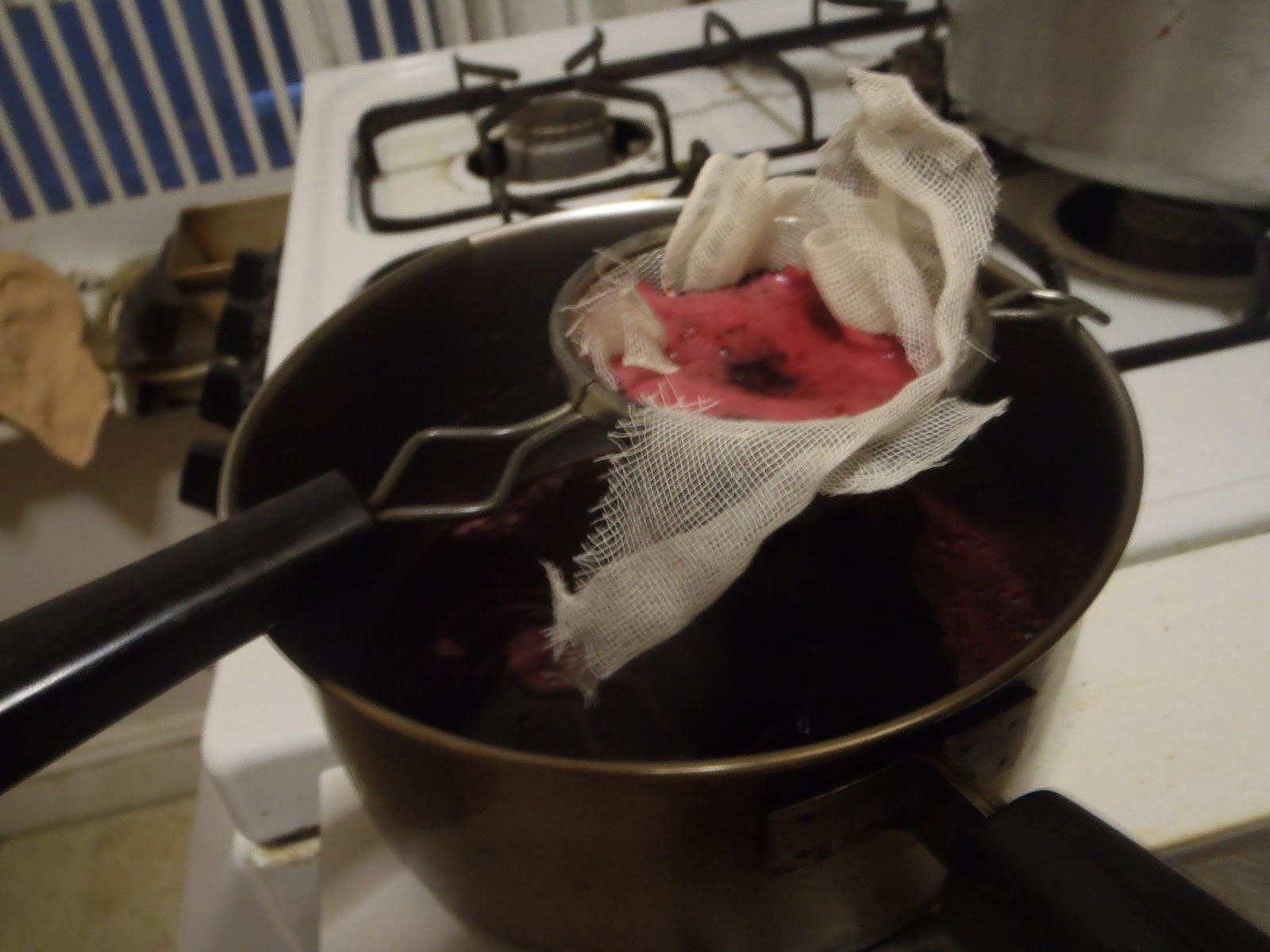
Part 4: Beet Essence. If you have a juicer or beet juice, you can skip this first bit. But if you DON'T, take your one lb of nicely sliced and diced beets and toss them into the blender. Add perhaps 3/4 cup of water and BLEND. Add more water if you can't get it to blend - what you are going for is a generous cup of the strongest beet water you can get. It's OK if it ends up a little extra watery - you'll be reducing this down to about 2-3 tbs, you just want all the beet essence you can get. So blend, blend, blend, then press it through a strainer and get all the liquid out you can. Then strain THAT through cheesecloth and a finer strainer (or a chinoise/tamis, neither of which I have. See my note on straining down in the Lobster Broth section.) Take this cup of now particulate-free beet juice, and reduce it slowly over low heat to 2-3 tbs of glaze - this will probably take 30-45 minutes, stirring occasionally, and skimming off any skuzz that may rise to the top. Is this worth it? Yes. Aside from the lobster itself, the beet essence turned into my favorite part of this dish, and if I had a juicer would happily make this beet juice on a regular basis for use in other dishes. Plate-licking good. There is one more step to finish this glaze, but that comes right before serving it.


Blanched leeks
Part 5: Leek mixture. You have all your veggie components sliced and diced at this point, and you are going to blanch each vegetable individually (leeks, carrots, turnip, and leek greens) until each part is soft. To blanch, boil some salted water, and prepare an ice bath (aka ice water). Taking each vegetable in turn (already sliced and/or diced), put the vegetable into the water until it is soft, but not mushy. You want them to be cooked, but still firm and full of color. Then immediately take the vegetable out with a strainer and drop it into the ice water until it is cool - this not only stops the veggie from cooking further, but helps it keep its nice color. I sometimes make string bean salad using this method.
Finished Brunoise

The leeks you should boil for a minute or two; for the diced veggies it shouldn't even take this long. Taste test them to be sure! Then once they've been iced, put them out on a paper towel and pat them dry(ish). Keep the leeks separate for now, but once the brunoise veggies are cooked, you can mix them up together into one big veggie mix. You can now mix the leeks with 1 tbs of the brunoise, the tomato diamonds, and 2 tsp of chives in a small saucepan. But before we can finish this part, we need to talk about butter.


BUTTER!!!!
Part 6: Butter. So now everything is almost ready to go: you just need to finish each of the components. To do this, you need BUTTER, or more specifically, Buerre Monte. So, I was amazed at this step, honestly, it was really cool and pretty simple to do. What you are doing is melting your butter in such a way that instead of separating out into the clear parts and the foamy parts, you end up with a thick butter liquid that still looks all creamy and buttery (see below). It's suprisingly easy, you just need a very little bit of water (about 1 tbs) and your butter. You need 2 cups of unsalted butter, cut into tbs chunks. In a medium saucepan, boil your 1 tbs of water, and ready your whisk.


finished buerre Monte
Reduce the heat to low, and start adding the chunks of butter bit by bit, whisking vigorously as you do so, as you emulsify your butter into the water. Once the process has started, you can just keep adding butter until you have the amount you need (in this case, about 2 cups) - you just need that 1 tbs to start. Keep the level of heat gentle and consistant, and keep whisking. You need to do this step right before you need to use the buerre monte, and keep it in a warm place until you do so, so that it doesn't break and keeps emulsified.


Part 7: Finishing Touches. Now that you have your buerre monte, you are ready for the finishing touches. Beet essence: bring the beet glaze to a simmer, then whisk in 3 tbs beurre monte, 1/2 tsp red wine vinegar, and a few drops of lemon juice to taste.  Leeks: heat the leeks, tomatos, chives, and brunoise with 1/4 cup plus 1 tbs of beurre monte until warm, then season with salt and white pepper.  Pomme Maxim: make sure they're in the desired shape, and reheat briefly in the oven until warm, 2-3 minutes at 300F. Lobster: The lobster should be at room temperature - place them in a wide saucepan and pour buerre monte over them to cover (about 1.5 cups, or the rest of the beurre monte). Put the saucepan over low heat and poach the lobster in the butter for 5 to 6 minutes, enough to heat through. The lobster will be cooked at this point, but it's cooked at such a low heat that the meat stays as soft and as tender as if it were raw. And once this is done, the poaching liquid (aka beurre monte) will have a nice sweet lobster flavor, which is completely reusable and amazing on toast, popcorn, and wherever else you might want to use butter. I have been happily using these leftovers!  Presentation:  On a small plate, put a spoonful of beet essence in the center. On this, place a generous tablespoon of the leek mixture. On this, artistically lay half a lobster tail, a claw, and the meat of one knuckle (aka, a quarter of a lobster). On top of THIS, place your pomme maxime chip at a jaunty angle. Enjoy!!!!

Finished dish, sans potato disk.

While our presentation was probably not as nice as it would be at the French Laundry restaurant itself, I thought that on the whole they turned out looking pretty good. But not as good as they tasted. Even if I don't do the whole rigamarole again, I will very happily poach my lobster in butter in the future, as that part was pretty easy (it was the rest of the preparations that took so much time!). The beet essence, again, was another amazing component I would also be happy to make on its own. The chip on top was tasty and crunchy, and pretty straight forward with the mandoline. And now that I have brunoise in the freezer, I'd eat the leeks again, too, but of the various parts, it was probably the least exciting and took the most work (all that dicing... I really need to remember to grab the food processor that is currently sitting in my parents basement for me).

As each lobster made 2 dishes worth, Benson and I were each able to have seconds, so that we had our whole lobster to ourselves. We probably could have eaten thirds if we'd made a third lobster to split! A complex dish, but truly, truly delicious. 

Searing the lobster shells/bodies
The creamy lobster broth, by contrast, was delicious AND simple to make, though we didn't finish it until the day after we had our lobster meal (we worked on the soup, but fridged the broth over night). We already had all the shells, legs, bodies, and whatnot from the lobster ready to go (remembering to remove all lungs, roe, and other stuff inside), leftover from the previous feast. So all we really had to do was roast the shells briefly in a pan (to make sure they were nice and red), then toss them in a pot with water and various extra ingredients and keep reducing the broth. The recipe called for 3 lobster bodies, but we had 2, so we just cut down the liquids by a third and kept the rest basically the same. The results were AMAZINGLY delicious, but also extremely rich. We got two small bowls of broth out of this... and neither Benson nor I could finish our bowls completely. It was simply... too rich, too much flavor, and our tastebuds simply got fatigued eating too much of it at a time. So we saved the second half of it for the next day and enjoyed it all over again. So if you make this, keep it mind it's definitely best in small portions - if I made it for a group I'd probably make about a shot glass per person - that would be enough to leave you wanting more, but not overwhelm you. (Incidentally, that seems to be the philosophy in general of food from the French Laundry - give you lots of small servings of amazing food, and leave you wanting more. In the case of the lobster itself, we were happy to eat more anyway, since we had it. In the case of the broth, a little bit went a LONG way). Anyway, here is the recipe for the broth - a definite must if you ever have lobster bodies and shells lying around - I'll definitely be making it again!

The amazing, rich, frothy, finished broth


Creamy Lobster Broth
1/4 cup canola oil
3 lobster bodies  (we used 2)
1.5 cups chopped tomatos
1/2 cup chopped carrots
1 bunch tarragon (1/2 oz)
1 cups heavy cream (we used 2/3 cups)


Making the Soup base

Take your lobster bodies and sear them with the oil over medium to high heat for a couple minutes, until they are well and truly red. Toss them in a pot, add the tomatos, carrots, and tarragon, and cover everything with water (you don't need to add salt). Bring to a boil, then let simmer for an hour - if any skuzz or impurities rise to the top, you can skim those off. This process doesn't require much attention. Once you've done this, strain the stock into another pot, smashing the lobster bodies to make sure all the liquid comes out.


Stock
You want to really strain the soup here and make sure there is no lobster shells, impurities, or little particulates. One of the things that Benson and I have learned from The French Laundry Cookbook is that straining your soups, sauces, and liquids increases the quality of your finished dish a LOT more than you might expect. There is even a page long entry in the cookbook titled "When in Doubt, Strain" - apparently the restaurant routinely puts sauces and stocks through an increasingly fine series of strainers 4 or 5 times before anything hits the table. So we ran the entirety of the broth through a tea strainer and cheese cloth, because we don't have a fine mesh chinois or tamis (a note to any readers looking for present ideas!). We have strainers larger than the tea one, but they're not nearly as fine, so we used those first, then moved on to the tea one. This took a while, but we have learned from past experience that it is worth it, so STRAIN your soup!

Adding cream
Next, take your now-particulate-free liquid and put it in a pot. You will now reduce this liquid (which is probably about a gallon of stock which doesn't taste particularly flavorful) to 2 cups (1.5 for us, since we started with fewer lobster bodies) - this takes a while, but again doesn't require much attention. At that point, the flavor is extremely concentrated, and, after straining it once more, we add one cup (2/3 cups for two lobster) of cream! Are we done? Of course not! Reduce this sucker down until it is once again 2 (1.5) cups of concentrated lobster goodness. This time you DO need to pay attention, because cream and heat can equal burning, so stir.

At this point, you take the broth, strain it one more time, just for fun, and put it in the refrigerator for several hours, to chill (or up to three days, according to the book). You want to do this so the flavor melds nicely - we left it overnight and that worked fine. Once you are ready to eat it, you put the cold broth into a saucepan and heat it on medium, whisking vigorously as you do so. You want it to froth up significantly, it seemed like it practically doubled in volume (though I didn't do a strict measurement of that). So once it's hot and frothy, you can serve it. In small, delicious portions. It is truly a delicious and surprisingly easy soup (and would have been easier if we had a LARGE fine mesh strainer, rather than a tiny tea strainer).
Soooooo goooooooood.

So the lobster resulted in two amazing meals - three, if you count the second lunch we had soup for. And I would definitely order live lobster again - while we did do a more complicated version of lobster, I'd be more than willing to try just doing a straight up boiled lobster, as well, if they were for a reasonable price and I didn't want to go too complicated. But I'd also very happily butter poach it again, since, if you ignore the extra veggies and sauces, that in of itself is amazing (and leaves you with leftover lobster butter - amazing on toast!). And when I do get lobster again, I will never ever throw out the shells. Even if I don't have time, I could just freeze them and make the broth some other time. Totally worth it!